


Smart Factory Hackathon: Coding For Audi's Production Of The Future
SINGAPORE, June, 2017 – Anyone who masters algorithms and programming is exactly right for this event: From October 4 to 6, 2017 the Audi Production division in Ingolstadt is holding its second Smart Factory Hackathon. In this competition, talented young data scientists from all over the world have the opportunity to demonstrate their abilities. The goal is to work out practical solutions for production processes of the future within 25 hours. Interested students and young professionals can apply immediately.


With their specialized knowledge of various subjects ‑ including IT, mathematics, business administration or communication design ‑ participants in the Smart Factory Hackathon will take on real‑life tasks from the areas of production and logistics in groups of three to five persons. With the use of anonymized data sets, they will work out solutions and generate real application cases. They will have 25 hours to do so, as a reminder of Audi’s 25th hour – the extra hour that drivers will gain in the future with autonomous cars. The participants will be able to consult Audi production and IT experts for advice. The tasks will focus on the key issues of big data, machine learning, deep learning and artificial intelligence. “Together with students and young professionals, we provoke some radical ideas with our Smart Factory Hackathon. This results in completely new approaches to complex problems. The goal of the Hackathon is to jointly implement the prototypes that are developed in reality,” explains the organizer of the competition, Kathrin Schwinghammer.
The first day of the event starts with an introduction to the Hackathon tasks and an individual tour of the plant that is adapted accordingly. The starting signal for the Hackathon will be given the next day. After the 25 hours, a jury will assess the proposed solutions in terms of their technical methodology, implementation, added value and potential. The teams will then make short pitches of their ideas to the public and the jury. These pitches will also have an effect on the final assessment. The rankings of the jury and the public will have equal weightings in deciding the winner.
The premiere of the Audi Smart Factory Hackathon in October 2016 was a great success. 16 teams from all over the world took part and developed software solutions for the factory of the future within 24 hours. Audi is currently following up about two thirds of the ideas and gradually integrating them in production in cooperation with the teams. One example is the idea of the winning team in 2016, Happy Unicorns. The Austrians developed a system for container management that allows the automated recognition, counting and classification of transport containers, and they are now implementing it together with their company as an Audi supplier.
For all creative minds that have some experience with coding and would like to take on new challenges: Applications for the Audi Smart Factory Hackathon 2017 can be submitted until September 1, the number of participants is limited. Please apply online at www.smart-factory-hackathon.de or www.smart-factory-hackathon.com
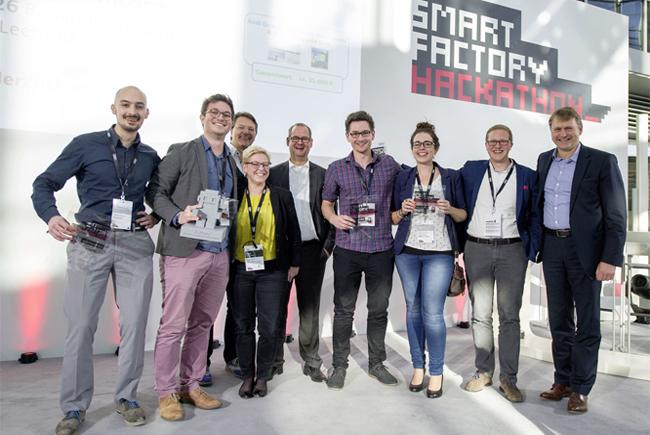
Credits:


Get the Best Price for your used car
from 500+ dealers in 24 hours









 Convenient and Hassle-Free
- Consumer Protection
Transparent Process
With No Obligation


